
The Rule of 72 is one of the most frequently quoted rules by financial advisors and investors.
Quite simply, it tells you how quickly an investment will double your money. Or, it tells you what compounded rate of return you need to double your money in a certain amount of years. Here’s the equation:
72 / [compounded rate of return] = [years until money doubles]

or

72 / [years until money doubles] = [compounded rate of return]
It is important to note that this is a compounded rate of return, which means it’s assuming your money continues to be reinvested throughout each year. If you get your money back in the investment, it won’t be compounded into the growth, and this formula won’t apply.
Let’s give a few examples. Let’s say you have an investment opportunity that you expect to grow at 10% a year.
72 / 10 = 7.2 years
So, if you invested $1,000, you would expect that to turn into $2,000 7 years later.
Let’s do the math just to see how that works, we simply multiply it by the increased percentage, in this case, that’s 100% (original value) + 10% (return rate), 110%.
| Year 1 | $1000 * 110% = $1,100 |
| Year 2 | $1,100 * 110% = $1,210 |
| Year 3 | $1,210 * 110% = $1,331 |
| Year 4 | $1,331 * 110% = $1,464.1 |
| Year 5 | $1,464.1 * 110% = $1,610.51 |
| Year 6 | $1,610.51 * 110% = $1,771.56 |
| Year 7 | $1,771.56 * 110% = $1,948.72 |
Now, you might see that we didn’t *quite* double the original income ($51.28 away), and maybe you get that in the “0.2” years of the “7.2 years” quoted above for doubling, but probably not. This brings us to a key aspect of the Rule of 72: it’s an approximation.
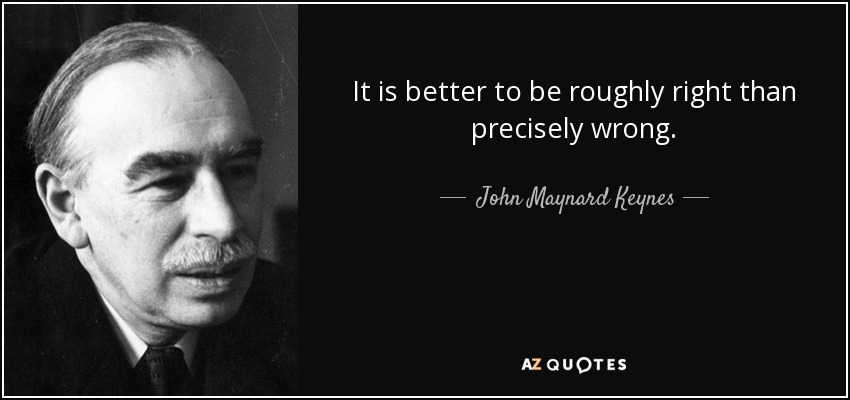
This quote from the famous economist John Maynard Keynes, and often repeated by the incredible investor Charlie Munger, is key to a lot of investing principles, including this one.
The whole point of the Rule of 72 is that you don’t need to do the precise calculation or even back-of-the-napkin-math. Someone says they have a deal for 7%? Quickly dividing 72 / 7 and you realize it will double in 10 years. In fact, most financial planners will tell you that your money will double every 10 years, that’s because they’re estimating you get a 7% return after fees.
Let’s quickly look at the other scenario. What if someone comes and says they’ll make your money double in 3 years? What rate of return are they expecting? 72 / 3 is a 26% compounded rate of return, which is really high!
Monish Pabrai, a well-reputed value investor, is so focused on this number he has this 26% on his custom license plate.
What if I want a precise formula?
A precise formula exists, but it’s significantly more complicated. Skip this part if you don’t want to get into the nitty-gritty.
The formula is:
logarithm(2) / logarithm(1 + [rate]) = [years]If we use the same example above and want to know how long it takes to double our money for 10%:
logarithm(2) / logarithm(1 + .10) =
logarithm(2) / logarithm(1.1) =
7.27254089734 years
You can see that the Rule of 72 was incredibly close: 7.2 vs 7.272…
The formula to figure out the inverse, rate of an investment based on the number of years, is even more complicated:
([final_value] / [initial value])^(1 / [years]) - 1 = [rate]So if we know it doubles in 3 years…
(2 / 1)^(1 / 3) - 1 =
2^(1/3)-1 =
0.25992105 compound rate
Again, incredibly close to what the Rule of 72 provided: 26% vs 25.99%.
You can certainly use these formulas, but probably not for everyday use. The Rule of 72 is much faster.
Who discovered the Rule of 72?
It was first mentioned by Luca Pacioli, an Italian mathematician and collaborator with Leonardo Da Vinci, who referenced it in 1494 in his book Summa de Arithmetica. That said, he didn’t provide any mathematical proofs or derivation of his work. Some people expect it to be even older and taken from another text.
To summarize…
The Rule of 72 is a quick method to approximate how many years a compound rate of growth will double an initial investment, or the inverse, and calculate the compound rate of growth from how many years it takes to double. It’s a good tool to have at your disposal when you want to do some quick math.
Remember that you can use this a few times over, for instance. Let’s say you are trying to plan for retirement and with your investment strategy you expect a ~7% return and your money will double every 10 years. If your retirement is 30 years away, you know that your money will double 3 times. So, if you had $10,000 in your retirement, then double that 3 times, $10,000 > $20,000 > $40,000 > $80,000.
Until next time!