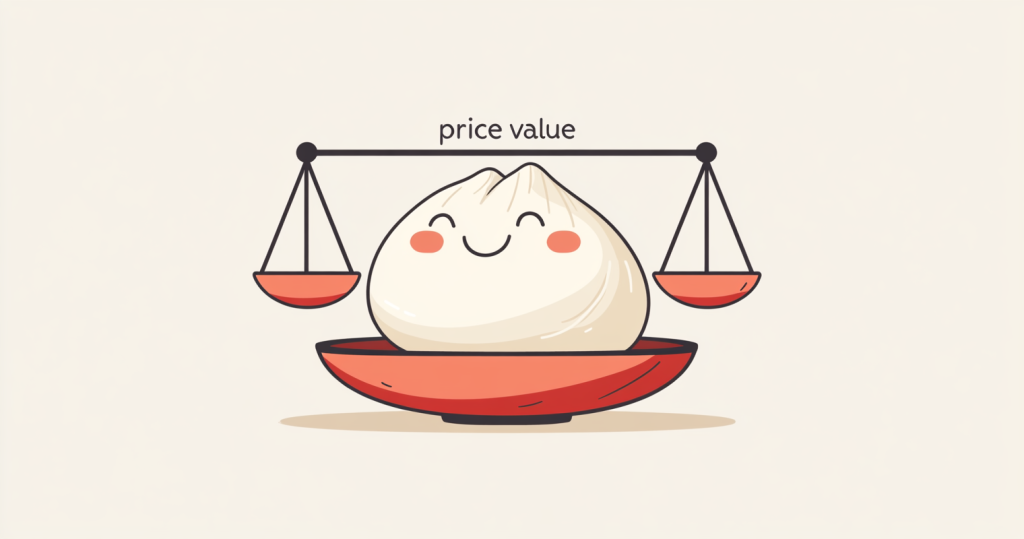
When you first enter the world of investing, these words often get used interchangeably, and quite understandably as I’ll get into later. One of the most basic tenets of value investors states that the way to beat the market is entirely based on the difference between price and value.
WHAT’S THAT?
Value investors are a investors who seek to invest based of principles of value investing, a style of investing spearheaded by Benjamin Graham, Warren Buffett’s teacher. This method places a lot of emphasis on determing what the value of any investment is and there are many books and courses focused entirely on valuation, a topic I will deep dive in a later post.
The price of a taco
Let’s say you really enjoy tacos, and they typically cost $5 per taco. You would say the price of a taco is $5. When you eat your tacos, you get filled with a sort of pleasure and satiation of hunger. This is the value of the taco.
But now it’s Tuesday, and not just any Tuesday, it’s Taco Tuesday. Tacos are now $3 per taco, the price has lowered by 40%! The value you get from it, the taste and satiation, are the same.
This would indicate that you are getting a better deal on Tuesday because you are getting the same value for less cost (or price).
What would you do for water?
A more typical example given of price and value difference is used with a simple question: what would you pay for water?
If a door-to-door salesman came to your house offering you bottled water at $1 per bottle, but you had filtered water in your house, it doesn’t make sense to buy it when you can get it for free.
That same bottle of water, however, if offered to you while you had been in the desert for 2 days, parched and desperate, might be worth $100, or even $1,000. In this case, you could say the “value” has also drastically increased, and therefore the price and value do match.
If you had planned ahead, and just a couple of days earlier bought your water for $1 per bottle, that would have been the same water available to you now and potentially save you $100 or $1000.
Price is what you pay, value is what you get
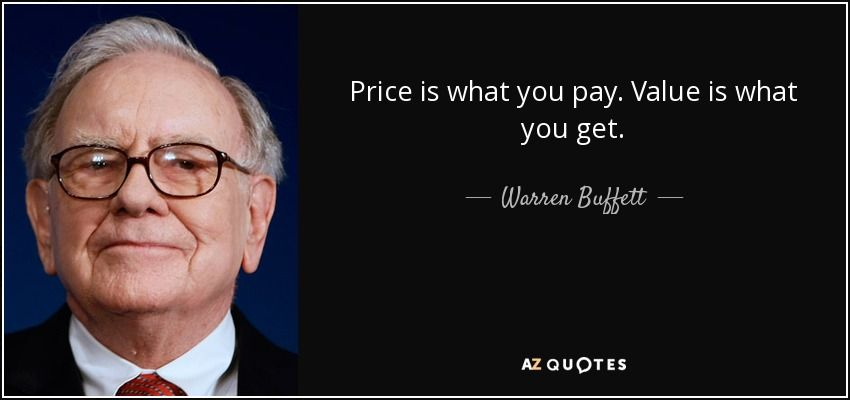
Buffett has a knack for simplicity, and his quote is a great one. In my previous article, Investing vs Speculating, I gave examples of the true value and the importance of buying only when the price is less. This concept is crucial to investing because if you can figure out the value of an investment, whether that’s a house, car, company, t-shirt, or a plum, you can figure out if you’re getting a good deal, getting good value for your money, if and only if you can see this difference.
Why, then, do so many people use them interchangeably?
Introducing the Efficient Market Hypothesis
We’re going to do a deep dive here, bear with me.
The Efficient Market Hypothesis (EMH), also known as the Efficient Market Theory (EMT), is a hypothesis that was laid out in the 1970s that said that stock prices reflect all known information about a given stock, and therefore it is impossible to find differences in price and value. The term market efficiency specifically means to what degree prices reflect value in a market. An efficient market would be one where they are completely equal.
This hypothesis became widely adopted in most financial schools because of “the teachings of the day” and has continued 50 years later, and it is used by most large financial markets. The author, Eugene Fama, received a Nobel Laureate for his work.
That said, it has become widely contested.
Robert J Schiller released a book in 2000, Irrational Exuberance, demonstrably showing that the market was inefficient (i.e. price did not equal value) through time. He also won a Nobel Laureate for his work.
Richard H Thaler released a book in 2015, Misbehaving: The Making of Behavioral Economics, in which he demonstrates another way that the market is inefficient. He also won a Nobel Laureate for his work.
Part of the theory states that an investor can’t beat the market in the long run. So, when you see someone like Buffett have a record of beating the market for ~70 years, it seems that there are practical exceptions to his work as well.
Many years after the original publication Eugene Fama himself stated:
“Nothing is perfectly anything so there has to be some amount of inefficiency in markets.”
Interview with Eugene Fama
-Eugene Fama
That’s a very, very important point. It’s one that most people agree on — the market is efficient, or that the price equals the value most of the time, nearly all of the time. But there is a small sliver of time when it’s not. And it’s when it’s not that you have an opportunity to beat the market.
Why is any of this important?
I want to be very clear here, as it may save you hundreds of hours and hundreds of thousands of dollars.
The only reason to study investing is to try to beat the market
If you believe that price equals value and that the market is efficient, then there is no reason to study investing. Every personal finance professional, book I’ve read, podcast I’ve listened to, and a great many investors believe that the common person, you and I, should not try to beat the market.
Many tools will allow you to match the market, at about 8% average yearly returns, with almost no time spent, and some of the lowest long-term risk. This is a very reasonable path.
If I have successfully convinced you that price does not equal value, then you have another choice.
You can try to find ways to beat the market. Most people who try to beat the market fail, and end up losing a lot more money than if they hadn’t tried in the first place. I’ve spent years, hundreds of hours, thousands of dollars training. I’ve maintained an average of 15% compounded growth — nearly twice the stock market average. My strategy and approach to getting these returns have changed a lot through the years. I think that you can make these returns without doing nearly as much as I have (and I’m hoping to share those with you all).
If you have any questions or comments, throw them at me, I love insightful questions and comments.