
Friend: “Have you invested in Bitcoin?”
Me: “No, what makes you think it’s a good investment?”
Friend: “I think it’s going to go up like crazy, and it just dropped down, great time to buy at a low and sell high.”
I have had many versions of this conversation about many different money-related activities that people all clump under this giant umbrella term “investing.”
Various other comments I’ve received when investing have been mentioned:
“Oh yeah, I’ve been diving into day trading/swing trading, so many people are making bank.”
“Isn’t the stock market like gambling?”
“Have you gotten any of the recent ____ NFTs?”
… and so on
To me, all of these come across as speculating. Let’s define speculation:
Spec·u·la·tion:
the purchase of an asset with the hope that it will become more valuable in the near future.
This has also been described as the Greater Fool Theory. This is the idea that you buy [anything] and hope that for some reason, it will go up, and you will be able to sell it to someone else for a higher price.
It’s called the Greater Fool Theory, because, in this example, you are the lesser fool. Why? Because there is no fundamental reason why the price should go up, and you’re relying on someone doing the same thing that you’re doing at a higher price.
“Past performance is no guarantee of future results” is a disclaimer that is legally required to be in front of many investments because it is so tempting to believe that when something has doubled or tripled recently, why would it stop? Unfortunately, in the great majority of cases, it does stop, and not just stop, but comes crashing down and losing the majority of your money.
So, if every time you are hoping something becomes more valuable is speculating, what’s the alternative?
In·vest:
to allocate money in the expectation of some benefit in the future.
The key difference here is that expectations are based on fundamental principles.
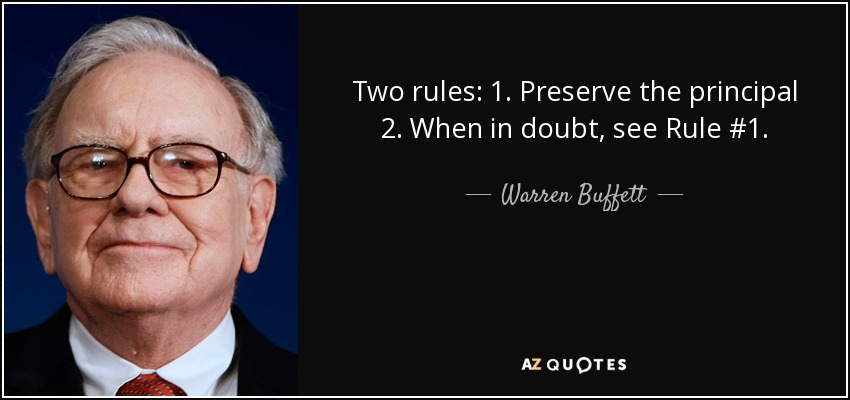
Many people read this quote as a facetious quip from Buffett, but it goes much deeper than that. He is saying that your focus should not be on how much money you can make, but on preserving your money. This principle is also known as capital preservation (capital is the money you put into an investment.)
Taking this concept further, his strategy is about buying different investments that are all but guaranteed to not go down. They may not go up either, but at least they don’t lose money. The idea is that if you have ten investments that have a very, very low risk of going down, but a potential to go up, you might have a few duds that don’t go anywhere, but you might get 2-3 that do moderately well and one that does extremely well, you have a very successful portfolio.
Why is this so important? Because it takes twice the amount of success to recover lost money. Look at this example:
Starting investment: $100.
Your investment loses 50%…
$100 loses 50% =$50
Now, to get back to $100, you have to increase it by 100%.
$50 increases 100% = $100
With these principles, let’s look at some examples.
Investing example: buying a Tesla
For a simple example, let’s say you’re looking at buying a 2024 Tesla Model S P100. You can see that its brand-new price is about $70,000. A barely used one might go for $60,000. You can see that these are being sold all the time for around these prices.
Introduce your rich uncle, who suddenly has a midlife crisis and decides he needs to move to a foreign country and wants to sell you his 2024 Tesla Model S P100 for $30,000 — a full 50% off from the full retail price. He shows you recent mechanic reports (which you can verify). You may not even need the car, you might just decide to resell it.
You could consider this an investment because there is a strong expectation that if you decided to resell this car you could get close to $60,000, profiting you $30,000. Even if you were wrong, or something came out in the news about some Tesla scandal, the price might drop a bit, maybe to $50,000, or $45,000. You still have made money on the deal.
Another way to define investing is that you have bought value at the time of purchase, rather than hoping time will increase the value.
Investing example: buying a house
A lot of people think real estate is a great investment. It absolutely can be, but it isn’t always. I’m going to simplify a lot of aspects, but a common response is that real estate prices always go up. I’ll talk about this more later, but it isn’t always true. Expecting an increase in real estate prices to fall into the speculation bucket because you’re hoping that they go up.
There are various ways to determine the value of a property, but the same principles apply. If a house is worth $100,000 and you buy it for $150,000 because you think the price will go up, this is speculating. If you buy it at $50,000, then you can expect that you have just made $50,000 on it — regardless of whether it increases value in the future.
Note: I am intentionally skipping over other key aspects of real estate investing, such as cash flow and tax advantages.
Margin of Safety
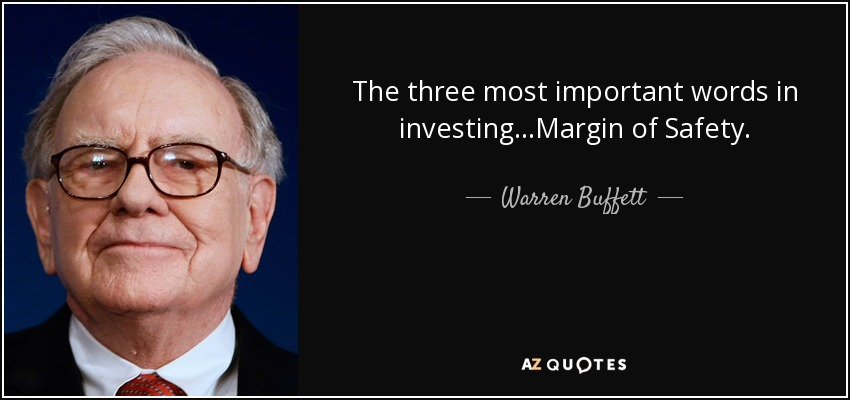
You may have noticed that in both examples I indicated this 50% price from the value of the investment. This difference, whether it’s 50%, 30%, or 10%, is called the Margin of Safety.
It’s one of the most fundamental investing principles, and I claim, you probably aren’t investing if you are not using a Margin of Safety.
This is a universal investing principle. It can be applied to the stock market, real estate, buying clothes, you name it. I’ll do another post on this in the future, but this should be enough for now.
Let’s review
If you look over all the examples in the beginning you might start to recognize the key aspects of whether it’s speculating or investing.
| Speculating | Investing |
| I think it … | I can buy it at a discount |
| It always goes up. | It’s significantly undervalued |
| I can make so much money in this deal | Similar items are selling at much higher prices |
| This is a growth stock | I have a huge Margin of Safety |
At this point you might be thinking that of course, you would like deals like this, but how do you find them? That’s the big part of investing — finding these deals, and I will show you some of my strategies in future posts.
Comment below or hit me up with any questions below!