
The Simple Path to Wealth Summary
Rating 5/5: 🌕🌕🌕🌕🌕
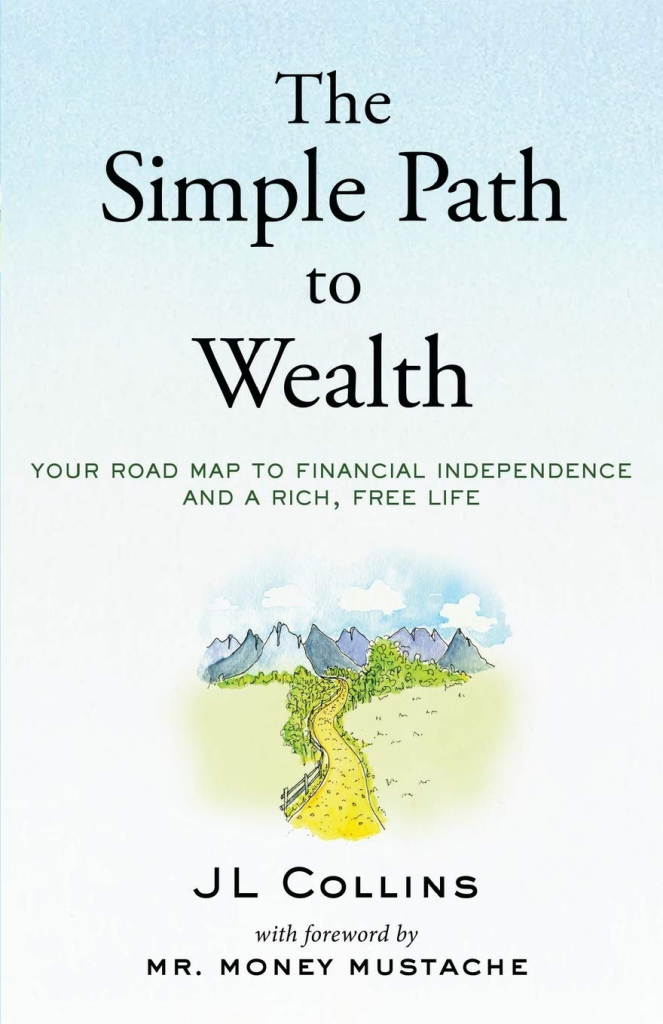
Ever feel overwhelmed by investment advice? The Simple Path to Wealth might be the book you’re looking for. As my second favorite personal finance book, it stands out for a strong reason: it actually makes investing simple.
Also, unlike most personal finance books, it’s clear that JL Collins has a stronger grasp of how the stock market works and gives advice based on this experience. While I don’t necessarily agree with all of his conclusions, I think that this is one of the best books out there.
He advocates one of my favorite engineering principles: KISS (Keep It Simple, Stupid). You might argue it also applies Occam’s Razor (a scientific and philosophical principle that states that the simplest explanation is usually the best one). His entire book is focused on the importance of keeping everything you’re doing simple, and after studying a plethora of behavioral finance and other related psychology of money types of books, I can’t emphasize just how important this is. It is also the opposite of some other books, such as Your Money or Your Life (although it is still a great book) which advocates tracking literally every penny of every expense, a crazy amount of spreadsheeting, charting, tracking, and other details.
This is one of the most recommended books in the FIRE community and he advocates for the typical 4% Rule method using Vanguard Index Funds. In fact, he harps quite a bit on why he believes index funds are the only good bet (one of my disagreements with my book, but that’s a later post.)
Key Takeaways
- Index fund investing: Collins strongly advocates for low-cost index fund investing, particularly in broad market stock index funds.
- Simplicity: The book emphasizes that successful investing doesn’t need to be complicated. Collins argues for a simple, easy-to-maintain investment strategy.
- Stock market as wealth-building tool: Collins explains why he believes the stock market is one of the most powerful ways to build wealth over the long term.
- Understanding market volatility: The book helps readers understand and accept market volatility as a normal part of investing.
- Financial independence: While not exclusively about FIRE, the book provides a roadmap for achieving financial independence.
- Debt avoidance: Collins advises readers to avoid debt, particularly high-interest consumer debt.
- Savings rate importance: The book stresses the significance of a high savings rate in achieving financial goals.
- Tax-advantaged accounts: Collins explains the benefits of utilizing accounts like 401(k)s and IRAs.
- “F-You Money”: This is a concept Collins popularized, referring to having enough money to provide the freedom to make life decisions without financial constraints.
- Wealth preservation: The book also covers strategies for preserving wealth once it’s accumulated.
Roadmap
Here is his roadmap. When your investments can support your lifestyle via the 4% rule (or similar withdrawal strategy), you’ve reached financial independence.
- Understand and control your spending
- Live below your means
- Avoid debt, especially high-interest consumer debt
- Build an emergency fund
- Aim for 3-6 months of living expenses in a readily accessible account
- Take advantage of tax-advantaged accounts
- Maximize contributions to 401(k)s, especially if there’s an employer match
- Utilize IRAs (Traditional or Roth, depending on your situation)
- Invest in low-cost index funds
- Collins strongly recommends Vanguard’s Total Stock Market Index Fund (VTSAX) or equivalent
- For those who want bonds, he suggests a total bond market index fund
- Asset allocation
- For wealth-building years: 100% stocks (or close to it)
- As you approach and enter retirement: Add bonds to reduce volatility (typically 75% stocks/25% bonds or 60% stocks/40% bonds)
- Stay the course
- Ignore market fluctuations and resist the urge to time the market
- Continuously invest regardless of market conditions (dollar-cost averaging)
- Rebalance periodically
- Once a year, realign your portfolio to maintain your desired asset allocation
- Consider real estate
- Pay off your home mortgage before retirement
- Be cautious about treating your home as an investment
- Plan for wealth preservation
- As your wealth grows, the focus shifts from accumulation to preservation
- Consider more conservative allocations and withdrawal strategies
- Achieve Financial Independence
- When your investments can support your lifestyle via the 4% rule (or similar withdrawal strategy), you’ve reached financial independence
Notes & Disagreements
I kept certain notes on various topics and disagreed with him on a bunch of other topics. A lot of them are “nitpicks”, but I think it’s important to note that a good book can still be controversial, and may be worth more research.
Debt
- Collins fails to differentiate good debt and bad debt (post coming soon…), perhaps because he wants to keep it so simple
- “If a debt is more than 5%, get it out of your life ASAP” – this is a semi-arbitrary number, but not a bad suggestion.
- He says don’t consolidate loans, but debt consolidation can absolutely help. He says “no debt is the goal”, but you could save significant real money with debt consolidation on your way to reducing debt.
- “Debt is always a dangerous tool. The history of commerce is littered with failed companies ruined by the debt they took one.“
- …but he fails to mention that successful businesses, the vast majority, also use debt. In statistics you must look at both the successful and unsuccessful attempts, doing otherwise is a biased result, and so just looking at failed companies inherently biases you if you’re not looking at the successful ones.
Warren Buffett
I consider myself a bit of a Buffett-ite as someone who has deeply studied his history, his annual filings, books, and classes, I’ve been to his annual conference, and so on. One of the most popular things finance books do is quote him out of context, pretend to ignore aspects of his advice or career, or simply use him to try to convey a point that doesn’t make sense. Collins does the same.
- He says he has “never met anyone that can do it [beat the market]. Never met anyone who has met anyone who can do it.” Did he never meet Warren Buffett or find anyone who has met him? This is absolute hyperbole.
- He says you “can’t just do what Buffett does”, but he’s wrong, you can: you just copy what Buffett does literally by his public filings and still beat the market. There was a study I once saw that if you had done this in 1970, while you wouldn’t have beaten the market as much as he did, you still would have reaped millions.
- He says there is “only one Warren Buffett”, but there are plenty of other fantastic investors who have beat the market over long periods. Here are a few: Prem Watsa, Mohnish Pabrai, Li Lu, Charlie Munger, Joel Greenblatt, etc. These are only the famous folks, a friend of mine, unknown to most of the investing world, has a 20% compounded growth rate for 20 years.
This exact argument was used against him through the ’70s and ’80s and someone called Buffett a statistical anomaly and said there was no chance it had to do with actual skill, and he rebuffed this with an article named The Superinvestors of Graham & Doddesville (his teachers). In this article, he names several more investors using the same value investing methodology, who also beat the market. - “Wouldn’t get into the ring with Ali or Fraser”, using an analogy to doing your own stock picking to beat the market. I agree, I would never do that, but one is genetics-based and the other is skill-based.
Roth Conversion Ladder
A Roth Conversion Ladder is a pretty cool concept that I only learned about in this book, and did more research later on. The problem with most IRAs or Roth IRAs is the fact that you have to wait until the standard retirement age, which is no bueno for those who want to do the early retirement path.
The Roth Conversion Ladder is essentially a way to turn your IRA with its tax-deductible contributions into your Roth IRA with its tax-deductible withdrawals, getting the best of both worlds. It sounds confusing at first but if you take a little bit of time, it can save you tens or hundreds of thousands of dollars. Here are a few of the resources I found on it:
- https://www.gocurrycracker.com/never-pay-taxes-again/
- https://www.gocurrycracker.com/gcc-vs-rmd/
- https://www.madfientist.com/traditional-ira-vs-roth-ira/
- https://jlcollinsnh.com/2013/12/05/stocks-part-xx-early-retirement-withdrawal-strategies-and-roth-conversion-ladders-from-a-mad-fientist/
- https://www.madfientist.com/retire-even-earlier/
DCA (Dollar Cost Averaging)
DCA is a common investing strategy for people who want to automate investing. It’s balances out high and low markets because when the market crashes you will be buying more stock at lower rates than if it rises when you will be buying less.
Collins is very specifically against doing DCA with a lump sum of money (imagine you inherited $100,000). He goes into some studies that show it’s better just to put it all into the market, as more often than not the market goes up over the long term. I agree with this, but it shouldn’t speak out against DCA itself.
Three thoughts:
- You don’t need to DCA lump sums, it can be based on income (each paycheck, invest a little).
- You could DCA a lump sum through the 10-month average length of a recession
- He mentions that there the market is “23% likely to drop in a year, 77% likely to rise” but a drop takes twice as much to recover from, so protecting the initial capital has a lot more value than just going up (which is done through DCA.)
Summary
JL Collins has written one of the better books in the FIRE investment community. His general principle is to keep everything incredibly simple, don’t sweat the small stuff. This means simple rules like eliminating all debt greater than 5%, living below your means, and investing everything into low-cost index funds. His suggested path to retirement is based on the 4% Rule.
JL Collins has written one of the better books in the FIRE investment community, and its impact extends far beyond just the mechanics of investing. His principle of extreme simplification – from eliminating high-interest debt to investing in low-cost index funds – provides a fresh counterpoint to the often overwhelming world of personal finance. While I disagree with his absolutist stance on debt and market-beating strategies, his core message of simplification has shown a clear path that most people can follow. If you’re drowning in complex financial advice and looking for clarity, this book is your perfect starting point. Just remember – like any financial advice, take what works for your situation and feel free to respectfully disagree with the rest, just as I have.